

The Difference Between Content Creation and Learning Design
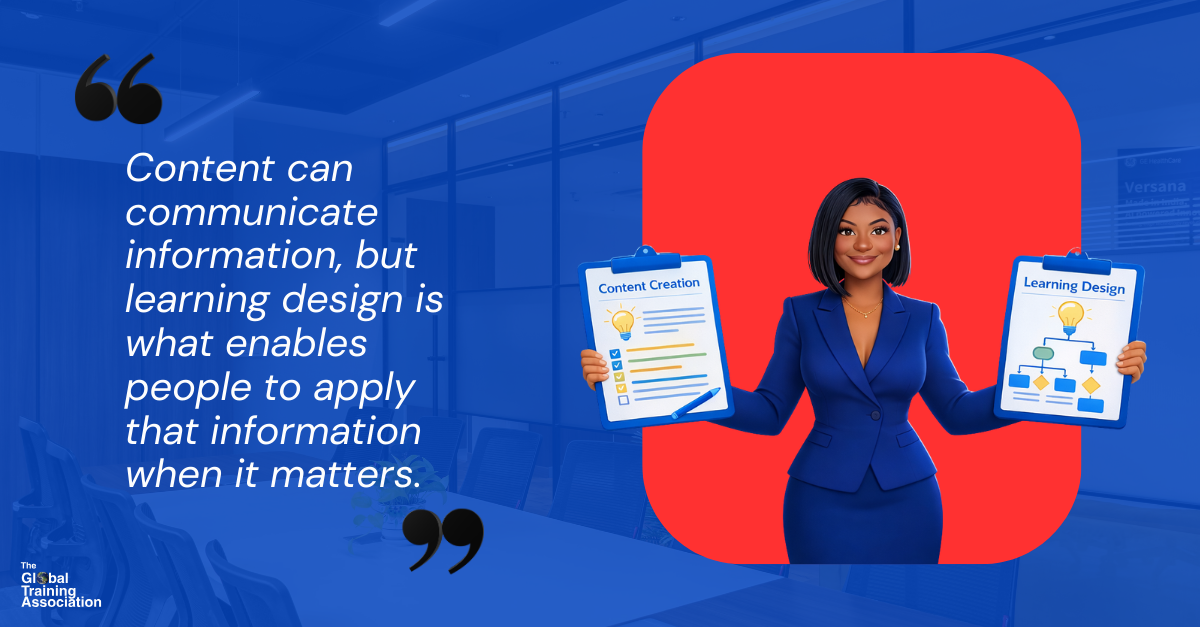
One of the most persistent—and costly—misconceptions in corporate learning is the belief that content equals learning. It does not. Content informs; learning transforms. Confusing the two helps explain why many training initiatives fail to deliver measurable results, even when they are well-produced and widely deployed.
“Content can communicate information, but learning design is what enables people to apply that information when it matters.” — Jakaria Ross
Content creation is primarily concerned with what people should know. Learning design, by contrast, is focused on what people must be able to do. This distinction is operational, not academic. In environments defined by complexity, risk, and speed, knowledge alone is insufficient. Performance depends on decision-making, judgment, and execution under real conditions.
A practical way for organizations to apply this distinction is to reframe how training requests are defined. Instead of beginning with topics or materials, leaders should first articulate the performance outcome they expect to change. When the desired behavior is clear, content can then be selected and shaped to support that outcome rather than overwhelm it.
Organizations today are not suffering from a lack of information. Employees are inundated with policies, procedures, dashboards, and resources. The challenge is not access; it is application. Can employees interpret information correctly in context? Can they apply it under pressure, with incomplete data and competing priorities?
“The real question is not whether employees have access to information, but whether they can use it effectively in the moments that matter.” — Jakaria Ross
A useful design principle in this context is to intentionally limit content volume. Learning experiences should prioritize the information required to make a specific decision or perform a specific task. Removing nonessential content increases clarity and makes room for practice, reflection, and feedback—elements consistently shown to improve transfer to the job.
Content-heavy training often creates the illusion of progress. Slides are thorough. Modules are completed. Learners finish courses and receive confirmation of completion. Yet little changes in day-to-day performance because the training rarely requires learners to exercise judgment, test decisions, or experience consequences.
Learning design starts from a different premise. It begins with behavior. Designers ask which decisions matter most, where people struggle, and what effective performance looks like in context. From there, content becomes a tool in service of behavior change rather than the goal itself.
“Learning design shifts the focus from what people are told to what they are expected to do differently as a result.” — Jakaria Ross
One practical way to operationalize this is to design learning around realistic scenarios rather than explanations alone. When learners must choose, act, and reflect, they engage the cognitive processes required for real performance. Content then supports those moments instead of replacing them.
This is why high-impact learning experiences often feel simpler rather than more complex. They emphasize relevance over volume and depth over breadth. They create deliberate space for practice, feedback, and reflection. Most importantly, they mirror real work conditions rather than idealized workflows.
Leadership plays a critical role in reinforcing this distinction. When executives ask for “more content,” they unintentionally lower the standard for effectiveness. When they ask for “better performance,” they elevate the conversation and create room for design decisions that prioritize execution.
“The questions leaders ask determine whether learning efforts produce activity or results.” — Jakaria Ross
A practical leadership habit that supports learning design is requiring success metrics beyond completion. Leaders should ask how performance will be measured after training and what support systems—such as manager reinforcement, job aids, or process changes—will be in place to sustain behavior change.
The difference between content creation and learning design ultimately shows up in outcomes. Content-driven training increases awareness. Design-driven learning changes execution. In competitive environments, only one of these creates a durable advantage.
Organizations that recognize this distinction stop measuring success by participation and start measuring it by capability. They invest in learning design expertise, not just production capacity. Over time, this shift improves not only training effectiveness but organizational execution.
“Content is easy to produce. Learning that changes behavior requires intention, structure, and discipline—but it delivers far greater value.” — Jakaria Ross
In the end, content will always have a role. But without learning design, it remains informational rather than transformational. Organizations that understand this difference move beyond training as an activity and begin using learning as a strategic lever for performance.
References
Clark, R. C., & Mayer, R. E. (2016). E-learning and the science of instruction (4th ed.). Wiley.
Merrill, M. D. (2002). First principles of instruction. Educational Technology Research and Development, 50(3), 43–59.
Salas, E., Tannenbaum, S. I., Kraiger, K., & Smith-Jentsch, K. A. (2012). The science of training and development in organizations. Psychological Science in the Public Interest, 13(2), 74–101.
Brinkerhoff, R. O. (2006). Telling training’s story: Evaluation made simple, credible, and effective. Berrett-Koehler.
Kirkpatrick, D. L., & Kirkpatrick, J. D. (2006). Evaluating training programs: The four levels (3rd ed.). Berrett-Koehler.